The latest findings from parishes’ Statistics for Mission returns show that, while October 2025 saw a small overall decrease in average attendance, the wider picture points to post-pandemic stability, strong children’s engagement, and areas of growth linked to local patterns of worship.
The diocese looked at church attendance in October 2025 and compared it with October 2024 and 2019, the last year before the pandemic, to help us understand how attendance has changed over time and what this might mean for how churches grow and develop in the years ahead.
The report combines attendance figures with insights from conversations across the diocese and with individual churches. We were able to compare 2024 and 2025 data for 544 churches, around two-thirds of all churches in the diocese. For the longer-term comparison between 2019 and 2025, we used data from 446 churches. Some churches could not be included because comparable figures were not available for all years, or because the data was incomplete or unclear.
Does attendance matter?
The mission of the Christian church is not so much to attract crowds to worship events as to make disciples and serve the Kingdom. But how do we know if we are fulfilling our mission effectively?
Counting attendance is one important pointer – an indicator of the numerical size of the Body of Christ. It helps monitor our success in holding and making disciples. It can show where we are making and where we are losing disciples. It can inform and challenge churches and dioceses about how we go about our mission in the future. Church attendance numbers do not tell us everything, but they can tell us quite a lot.
Summary
October 2025 saw the first decrease in attendance since the pandemic; attendance as measured by the Average Weekly Attendance (AWA) saw a small decrease of 1.4% between October 2024 and October 2025 overall in the Diocese of Oxford.
Adult AWA decreased between 2024 and 2025 by 1.6%, whereas over the same time period there was no change in the child AWA. If this decrease had been seen across all our churches in the diocese, it would represent 540 fewer adults and no change in the number of children attending our churches. This may not mean a loss of 540 adults from church; instead, it may be some people coming to church less frequently each month, for example.
The small decrease in attendance of 1.4% between October 2024 and October 2025 was not reflected in a separate analysis comparing 2025 October attendance figures with those for 2019; this showed attendance in 2025 at 86% of the 2019 level, the same level as seen in 2024.
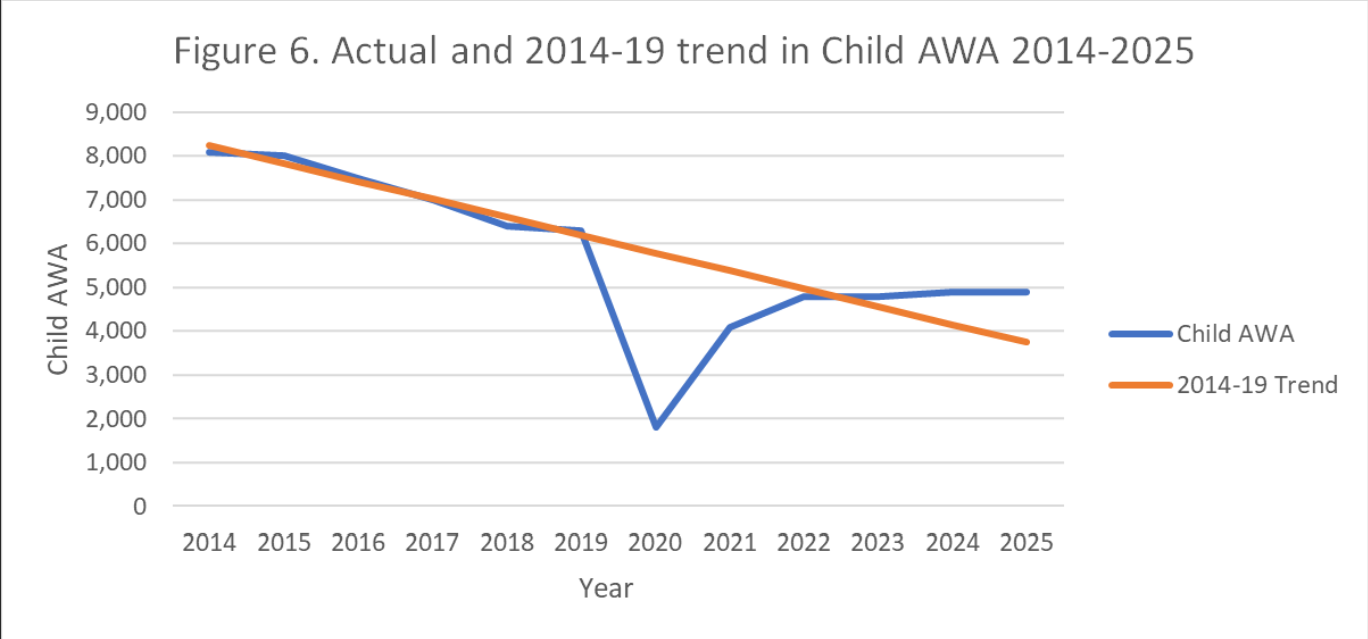
If the pre-pandemic trends (from 2014 to 2019) had continued, our estimates show that in 2025 Adult AWA, while still being below its 2019 level, was 1.7% above the projected pre-pandemic trend. Child AWA, however, has exceeded the projected trend figure since 2023, and in 2025 the Child AWA was 31% above the projected trend. However, it should be noted that child attendance was declining at a faster rate than adult attendance prior to the pandemic. Therefore, whilst overall average attendance did show a small decline, this is a slower decline than seen in the years before 2019.
If we just consider Sunday attendance, however, average Sunday attendance between 2024 and 2025 increased slightly by 0.2%, with adult average Sunday attendance increasing by 0.1% and child Sunday attendance by 0.8%.
Whilst the overall change in AWA between 2024 and 2025 was a decrease of 1.4%, this varied considerably by Archdeaconry, with Oxford seeing a decrease of 3.5% whereas Dorchester saw a very small increase of 0.2%.
Adults saw a decrease in AWA in all archdeaconries, whereas three of the archdeaconries saw an increase in child AWA – the fall of 3.7% in child AWA in Berkshire resulted in no overall change in average child attendance across the diocese.
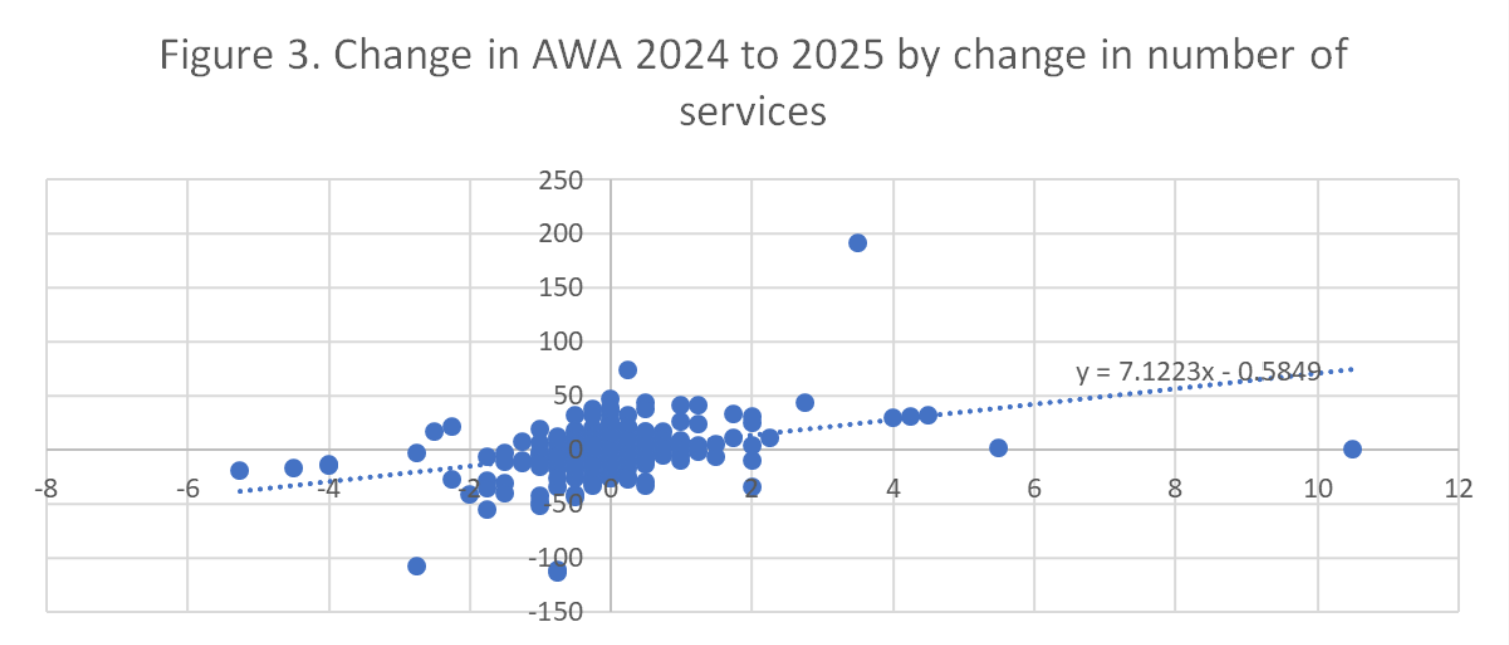
Between 2024 and 2025 the number of services offered across the diocese fell by just a few. However, those churches that held between 1 and 4 fewer services in 2025 than in 2024 saw on average a decrease in AWA of 10%, and those that held 5 to 10 fewer services saw a decrease in their AWA of 24%. Those that held the same number or more services in 2025 saw in increase in their AWA of 4%, and 5% in their child AWA. On average if a church held one extra service a week compared with 2024, it was associated with an increase in AWA of an extra 6.5 people attending per week.
Archdeaconry
Whilst the overall change between 2024 and 2025 was a decrease of 1.4%, this varied considerably by Archdeaconry, with Oxford seeing a decrease of 3.5% whereas Dorchester saw a very small increase of 0.2%.
Adult AWA decreased between 2024 and 2025 by 1.6% whereas over the same time period there was no change in the child AWA. Adults saw a decrease in AWA in all archdeaconries, whereas three of the archdeaconries saw an increase in child AWA – the fall of 3.7% in child AWA in Berkshire resulted in no overall change in average child attendance across the diocese.
| AWA | Adult AWA | Child AWA | |
| Oxford | -3.5% | -4.2% | 3.7% |
| Berkshire | -1.9% | -1.5% | -3.7% |
| Buckingham | -1.1% | -1.5% | 2.3% |
| Dorchester | 0.2% | -0.1% | 2.0% |
| Total | -1.4% | -1.6% | 0.0% |
Numbers of services
Comparing 2019 October AWA with that in 2022 saw that the decrease in AWA between the two years was associated with a similar fall in the number of Sunday services offered by churches. So, one explanation for the fall in AWA was that rather than there being fewer people at each service, the total might be down because there were fewer services.
Between 2024 and 2025, the number of services offered across the diocese fell by just a few. However, those churches that held between 1 and 4 fewer services each week in 2025 than in 2024 saw on average a decrease in AWA of 10%, and those that held 5 or more fewer services saw a decrease in their AWA of 24%. However, those that held the same number or more services saw in increase in their AWA of 4%, and 5% in their child AWA.
Rurality
Adult AWA fell between 2024 and 2025 for both churches in an urban and a rural context. However, child AWA fell by 6% in rural churches but increased by 2.8% in urban churches. The urban churches on average tend to be larger and therefore more likely to have resources for a children’s worker which in turn will attract more children to church.
Longer-term trends
Studying October 2025 attendance data together with projected pre-pandemic trends doesn’t tell us what would have happened if there had not been a pandemic, but shows what would had happened if the pre-pandemic trends (from 2014 to 2019) had continued. The 2025 figures are estimated from our sample of linked 2024 and 2025 information and assume the remaining churches in our diocese show the same overall average changes in Adult and Child AWA.
These estimates show that in 2025 Adult AWA, while still being below its 2019 level, was 1.7% above the projected pre-pandemic trend. Child AWA, however, has exceeded the projected trend figure since 2023 and in 2025 the Child AWA was 31% above the projected trend. However, it should be noted that child attendance was declining at a faster rate than adult attendance prior to the pandemic.